References
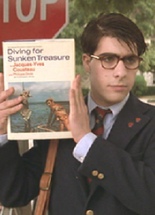
LiteratureDiving for Sunken Treasure
by Jacques-Yves Cousteau and Philippe Diole (out of print) -
Inside Max finds an intriguing quote: "When one man, for
whatever reason, hast he opportunity to lead an extraordinary
life, he has no right to keep it to himself." -- Jacques-Yves
Cousteau. This quote leads Max to Miss Cross.
Kidnapped
by Robert Louis Stevenson - Miss Cross is reading this book to
her students when Max sees her for the first time: "I have
seen wicked men and fools, a great many of both, and I believe
they both get paid in the end, but the fools first."
20,000
Leagues Under the Sea
by Jules Verne - Miss Cross is reading this book on the
bleachers the first time she encounters the eccentric Max Fischer.
The
Powers That Be by David
Halberstam - Max has this book during his first encounter
with Miss Cross. Director Wes Anderson notes that Max
probably wouldn't get much farther than the current bookmark and
was more than likely attracted to it by the name.
"Elegy Written in a Country
Churchyard" by Thomas Gray -- "The paths of glory lead
by to the grave."
Film
Style Influences
Chinatown
(1974)
The Conformist
If...
(1968)
Jules
& Jim (1962)
Rosemary's
Baby (1968)
Tone Influences
Brewster
McCloud (1970)
The
Graduate (1967)
Harold
and Maude (1971)
Lucas
(1986)
Peanuts (recommended: A
Charlie Brown Christmas)
Parodied in Rushmore
American
Me (1992)
Apocalypse
Now
Heaven
and Earth (1993)
My
Left Foot (1990)
Hell
Is for Heroes (1962)
Casualties
of War (1989)
References
As Max is placed on academic
probation for his poor grades, he requests that Dr. Guggenheim
help him for "old times' sake." Guggenheim
replies, "Can't do it, Max." The scene parallels
one in The
Godfather, which is
somewhat ironically directed by Francis Ford Coppola, Jason's
uncle.
Wes and Owen felt that many scenes
in the movie were influenced a large amount by The
Graduate. Water
plays an important role in both movies. For example, Mr.
Blume seeks refuge from the party at the bottom of the pool just
as Benjamin does in The Graduate. Also, while Max
Fischer was originally supposed to be like a "young Mick
Jagger," the selection of Jason transformed the character
into one that resembles Benjamin (played by Dustin Hoffman) in
many ways.
Max's encounter with the security
guard or teacher during his use of the payphone was inspired by a
documentary called "High School" by Frederick Wiseman.
The fires burning in the cemetery
were inspired by a similar scene in Daisy Miller.
The scene in which Max purchases
dynamite and asks for it to be billed to "Ready Demolition,
Tuscon, Arizona" parallels a scene in Heat,
Several films are parodied in Max's
play "Heaven & Hell" including Platoon and Full
Metal Jacket. However, the play is largely based on Apocalypse
Now. Dirk's slow
motion scene with the flame thrower comes from Hell
Is for Heroes.
The scene during the play's
intermission is based on Barry Lyndon.
|